Speaking of Coriolis, it has the best trailer I've ever seen for a pen and paper table-top role-playing game. Way to promote an original concept, guys!
Showing posts with label gaming. Show all posts
Showing posts with label gaming. Show all posts
Sunday, February 10, 2008
Tuesday, September 18, 2007
Halo 3 ads
Apparently, the US is riddled with Halo 3 tie-in ads, which managed to drive multiple gamer web comic makers insane on the same day. Here's Penny Arcade's take on the situation, and here's Ctrl-Alt-Del.
Now, I usually think Penny Arcade is the funnier comic, but in this instance, when the subject matter is absolutely identical, I think CAD did a better job. However, I found the punchline weak. Why not just remove it in favour of a blank stare of pure disgust?

CAD is the Garfield of gamer comics.
Saturday, September 15, 2007
Compatibility ftw!
I got an e-mail yesterday that is probably very cryptic to people not in the know, but very informative and a source of relief to those who are looking forward to duelling Slash and Tom Morello:
Dear Customer,

GH III for Ps2 is compatible with the sg controller.

Thank you,
RedOctane Customer Service
Wheeee!
Monday, August 06, 2007
LEGO Hero

Saturday, July 28, 2007
Nothin' but a short time
I only bought the game yesterday, but I have now played through Guitar Hero: Rocks the 80s on both Medium and Hard. It's not as if I played it non-stop either; it took maybe four or five hours in total. There are only 30 songs in career mode, and no bonus songs. That kind of pissed me off, because I wanted to hear some 80s style rock from contemporary bands, maybe some Harmonix employees.
In contrast, Guitar Hero II had 40 songs in career mode and 24 bonus songs. Length-wise, Rocks the 80s really is a joke in comparison, and most of the in-game artwork consists of poor rehashes of content from Guitar Hero II. Calling it an expansion and peddling it as a full-priced game to wide-eyed Guitar Hero fans itching for their next fix is just mean. Is Activision hedging their bets by making the game just replayable enough that we'll be bored of it by the time they release Guitar Hero III (which will cost only €3 more than Rocks the 80s)? Is Harmonix pouring their souls into Rock Band, while just fulfilling some contractual obligation by completing Rocks the 80s? Probably a bit of both.
I have to admit though, a lot of the songs were really good, and some came as pleasant surprises since I made it a point not to read the track list beforehand. I got so much neck-button mashing action that I got a bit of a cramp in my left hand, and I think I'm getting the hang of hammer-ons and pull-offs. I finally noticed that those notes don't have a black outline. So thanks for the exercise, guys. Now where's the rest of the game?
Friday, July 27, 2007
I Wanna Rock
I got Guitar Hero: Rocks the 80s today. Can't wait to get home and play it! :)
UPDATE: Way too few songs. Remember how I said that the first two games were too short? It's like they wanted to prove me wrong and show me what a short game really is.
Sunday, June 24, 2007
Thy next foe is...
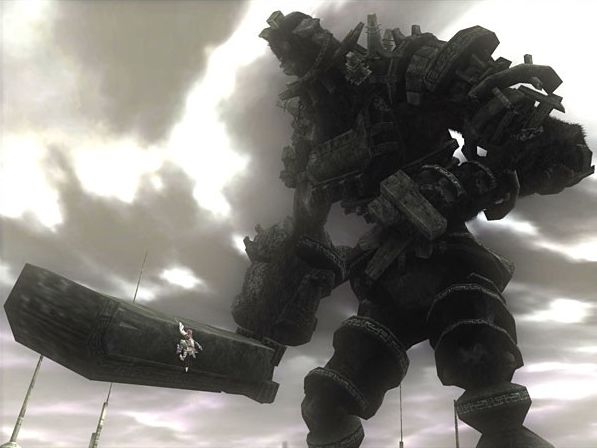
Every time I am faced with another colossus, defeating it seems an impossible task. What could I possibly do that would even faze these enormous creatures? I am an ant in comparison to these insurmountable obstacles, each one a new adventure, another unique challenge. The dizzying heights, neck-breaking speeds and mortal dangers leave me sweating and shaking with exhaustion, even though I am sitting safely on this side of the screen, controlling the protagonist via a gamepad and watching the action play out before me. Because I am of course talking about a video game, namely Shadow of the Colossus for Playstation 2.
I am a severe latecomer to the world of PS2 gaming -- in fact, I only just bought the console some week ago after being mesmerized by Guitar Hero, and then recently decided to get a few cheap games. Shadow of the Colossus is more than a year old now, but it still looks good (and sometimes amazing) if you can coax some 480p action out of the PS2. Just getting my hands on the required component cables to take advantage of the higher resolution was somewhat of an adventure in itself, as most game stores nowadays only carry accessories for Xbox 360, PS3 and Wii. I found PS2 component cables online, but didn't want to order accessories from some unknown web shop. I finally found an actual real-life shop that has component cables right here in Stockholm; the appropriately named psXcare. Thanks guys, now I can defeat colossi in twice the resolution!
As a side note, I was a bit ticked off at first by the sound lagging behind very noticeably in cut scenes when playing in progressive mode, but then I switched from PAL to NTSC, and now it's in sync again. Apparently, it was that age-old "timing based on hertz" problem that I thought died with the 80s.
When I first got the game, I was a bit anxious that it would be too hard for me, since I'm not much of a gamer. As it turns out, it's very forgiving, despite pitting you against otherwordly giants that would just as soon crush you underfoot as look at you. Firstly, the game only consists of two elements; finding a colossus and defeating it. That's it. Finding the next colossus involves riding across the land on your trusty steed and holding your sword up to the sun to see in which direction it focuses the sunrays; that's where you need to go. Most jumping puzzles take place during the actual felling of the colossi, and there are no other irritating enemies running about. Secondly, falling off a colossus or getting stomped on usually doesn't kill you instantly. One of the worst things that can happen is that you lose half your health and your consciousness for a while, which leaves you very vulnerable to any further attacks. However, if you can just get out of harm's way for a while, your health is automatically replenished. Of course, if your health meter is depleted, it's game over, but you don't have to load a game and ride all the way to the colossus again; you get to start over from the moment you found it.
Once again, this is what I would call soft obstacles. There is no instant failure, and every time I fall off a colossus I feel like I've discovered something new about it that might help me defeat it. Still, I'm only half way through the game and I've almost given up twice. The problem is that it's too linear. There is only one colossus to fight at any given time, hence the title of this blog post, the phrase with which every mission starts. You can easily get stuck on one colossus with no clue as to how to defeat it, or just get frustrated by how hard it is. If there had been two or three colossi to choose from, you could leave one for later and defeat a few of the others instead, thereby maintaining the flow of the game. Granted, multiple colossi might make finding them a whole lot harder. It would be slightly akin to having a compass needle that not only points north, but also towards Havana and Sofia depending on which way you're facing. Any potential solution might break the design of the game, which is elegant in its simplicity.
So while Shadow of the Colossus is not perfect, it's an extremely satisfying experience. The music is great, the colossi are awe-inspiring, and the story seems to build up to what I hope to be a heart-wrenching and memorable finish. Now if you'll excuse me, I believe I have a sand worm to slay.
Saturday, June 16, 2007
Saturday, June 09, 2007
I hate you, Stevie Ray
I finally completed Guitar Hero 1 on the Hard difficulty setting yesterday.
That is all.
Tuesday, April 10, 2007
Squeedly vs meedly
"Guitar Hero II might appear to be a game, but it's actually composed of cleverly packaged pockets of productivity-sucking awesomeness created by Satan." - Total PlayStation
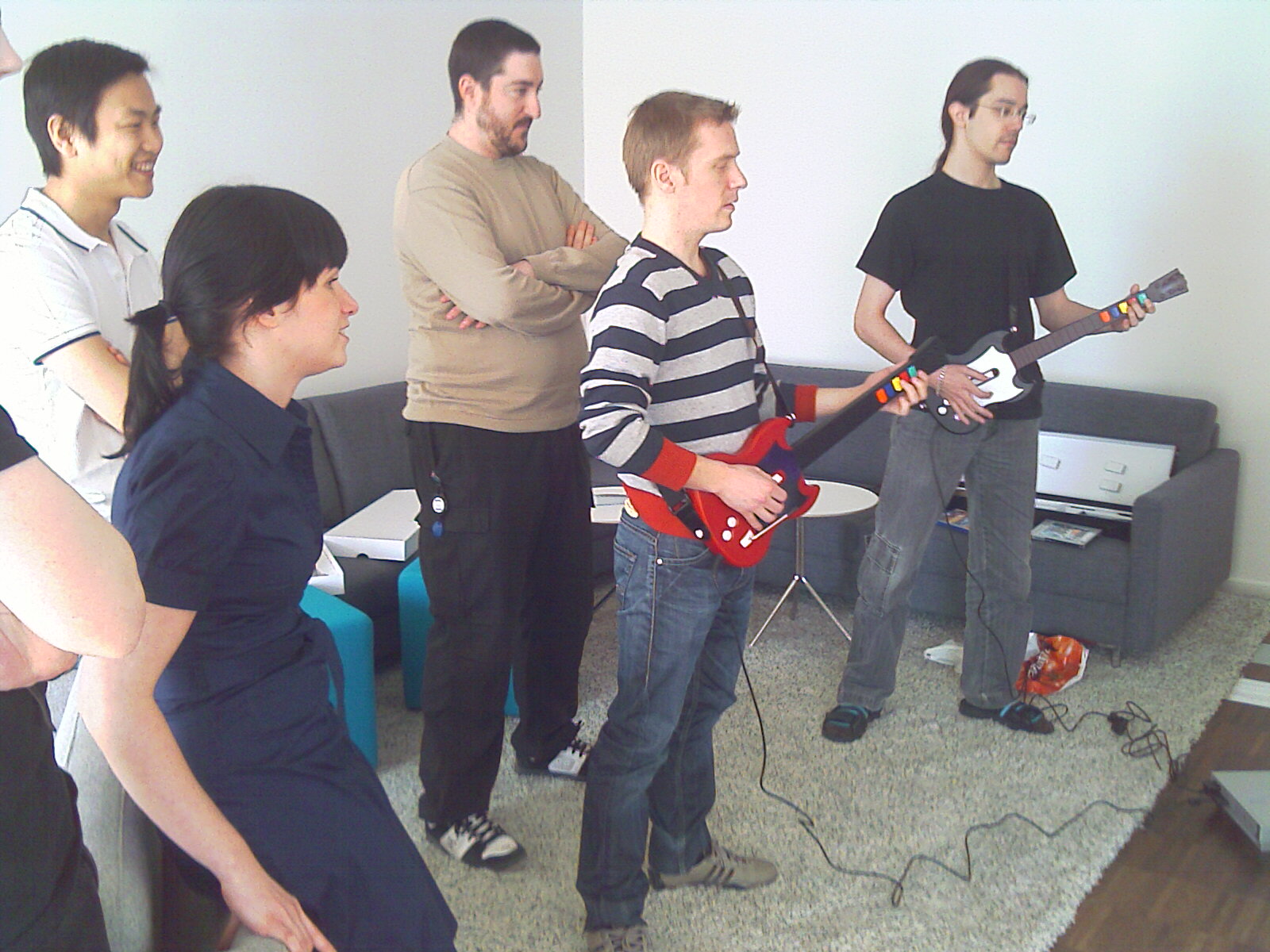
Thus began my downfall. The game harbours a ridiculous amount of fun, especially in the multi-player modes. It's entirely skill-based and chock-full of soft obstacles, which suck you into the flow of the game. It's hard to stop playing, when you can always play "just one more" song, or play a song again and again to nail those awesome solo licks. When my younger brother and one of his real-life band mates came to visit during Easter, our living room was suddenly transformed into a rehearsal studio when they decided to hone their skills on Killing in the name of, playing it maybe 15-20 times in a row.
The game is deceivingly easy to get started with if you have some rhythm perception and hand-eye coordination, and is nearly open-ended if you strive to perfect your scores on the expert difficulty. In other games, different difficulty levels do not equate replayability, at least to me, since the added difficulty doesn't add to the experience. In Guitar Hero, the higher the difficulty, the more your fingers are following the licks and riffs, and the more it feels like you're actually playing the song. Speaking of difficulty levels, the separate difficulty settings in cooperative mode is a stroke of pure genius. Now my brother, former guitar virtuoso, and his girlfriend, self-proclaimed music illiterate, can play together and thoroughly enjoy themselves.
Basically, Harmonix have done everything right. The only possible fault I can find is that the games are too short. I eagerly await Guitar Hero III and Guitar Hero: 80's edition.
Sunday, March 11, 2007
Alternate reality
A game belongs to the alternate reality genre if its in-game world crosses over into the real world. That in and of itself is a rather interesting concept, although whenever I read about Majestic back when it came out, I kept thinking that it seemed like too much work. You have to interact with things in the real world to play the game, which often involves calling phone numbers or searching the web in order to reveal clues that advance the plot of the game. If you'll recall, I'm a very casual gamer. Searching for clues in video clips or painstakingly assembling stray words in background images from different websites to figure out which book they're quoted from doesn't seem very appealing to me.
Alternate reality games (ARGs) always seem to suffer from two faults: the solid wall and the deforestation. ARGs are a solid wall when they are composed of too much information/disinformation (I Love Bees) or too little information (The Lost Experience), so that you can't even see which part is a clue, or if it's even a game at all. Even if you do, you can't follow the clues if you don't spend an inordinate amount of time on them, which is hard if you have a life or a job. Most ARGs also suffer from deforestation, in that they are often being played by thousands of people simultaneously, so there is nothing new for you to discover. The web is plastered with clues and spoilers that are hard to avoid if you're actually trying to play the game. Your quiet stroll through the forest, picking your favourite flowers, has been destroyed by masses of people trampling every flower underfoot.
Like Majestic, ARGs often strive to seem real, and to make you think you're not playing a game. More often than not, you aren't. These days, ARGs are just big hype machines, utilizing the new and hip "viral marketing" concept to ingrain yet another trademark deep into your consciousness. I Love Bees was a complicated advert for Halo. The Lost Experience took it even further by endorsing Sprite, Jeep, Verizon and Monster.com. And now, for some reason, Nine Inch Nails has succumbed to this form of advertising with an ARG promotion of the upcoming album Year Zero.
I admit that the concept for the album is cool, but that's no thanks to the ARG. Trent Reznor wrote the concept; the ARG is just obstructing and cheapening it by in essence being a silly hype machine. I do enjoy looking at some of the websites and seeing The Presence, but I can't help but feel the deforestation syndrome. Each one of these websites is already plucked clean of every piece of information. Where's the reward in finding something that someone else has already found?
It's not all bad though. I like the "leaked" MP3s (a very bold move), and the teaser trailer. I suppose a good thing about viral marketing ARGs is that they're free, and I can choose my own level of involvement. However, in most cases my involvement is close to none.
Thursday, February 01, 2007
Game design
I'm a casual gamer. I tend to get frustrated by certain types of games, and lately I've been trying to identify which aspects of games I like or dislike. Here's what I've come up with so far.
- Easy to learn, hard to master
If I need to go through 10 minutes of tutorials before I can understand the basic gameplay, chances are I'll turn off the game and move on. Like any entertainment, games should hook the audience. Story-wise, jump straight into the action and leave the exposition for later. Game-wise, start off with a ridiculously obvious control scheme (from the developers' point of view), hint at the unique aspects and depth of the game mechanics, and let the player delve into them later while actually playing the game.
Good example: Prince of Persia: Sands of time does a good job of extending standard platform gaming in an interesting way.
Bad example: EVE. I stopped playing after a good 40 minutes of just creating a character and sitting through what seemed like endless tutorials. I guess that game isn't for me. Another bad example is Prince of Persia: The two thrones, which demonstrates the other extreme in how it throws the dark prince at you and leaves you to try to figure out the control scheme on your own, on a time limit. Don't know which button to press, through some mysterious telepathic connection to the game designer? Time's up, start over.
- Soft obstacles
This is a term I made up for something that I want to see more of in games. Most games are basically made up of obstacles; different problems and situations that you have to get past in order to reach the goal. A hard obstacle makes that goal seem unattainable and frustrates the player. A soft obstacle doesn't stand in the way of progress. Every time you try to overcome it you either partially succeed, gain some new insight into how to overcome it, or noticeably increase your skill. You may even receive an explicit reward for trying. In other words, soft obstacles maintain a level of hope and bait you to keep playing by keeping the goal in sight. A good way to achieve soft obstacles is to have several mutually independent obstacles (i.e. parallel missions) and open-ended gameplay. Let the player take a break from the game without actually shutting it off.
Good example: Even if I lose a race in Need for Speed: Carbon, I feel that I've honed my skills, learned the layout of the track, and come closer to unlocking another cool upgrade for my car. Another good example is Grand Theft Auto, where the open-ended gameplay allows you to blow off steam between missions.
Bad example: A lot of adventure/quest games, where you customarily get stuck and can point-and-click your way around for several hours without even understanding the overarching goal, much less which pixel the designer wants you to find, or which inventory objects you're supposed to combine for no obvious reason in order to advance the unrelentingly linear story. Getting stuck represents absolute downtime; you're just watching the character walk around. That's not entertainment. I might as well watch my screensaver (currently set to "Blank").
- Failure as a game mechanic
If the player regularly sees a "game over" or "mission failed" screen and has to start over or load a saved game to complete the game, then failure is an integral part of the game mechanics. I've gone back and forth on this issue, since some games actually do this well. My conclusion is that you should be very careful with this. If you absolutely need failure, make it as non-frustrating as possible. Don't punish the player for playing within the rules of your game.
Good example: Somehow, Splinter Cell: Chaos Theory doesn't annoy me with its constant save/load cycle, and instead makes me think that I can sneak past another obstacle after the next load. Another good example are the LucasArts point-and-click adventure games, in which failure simply doesn't exist.
Bad example: Any old Sierra quest game. In fact, I habitually refer to this kind of poor game design by simply calling the game a "Sierra game", usually with added expletives for flavour.
- Replayability/moddability vs extensibility
The business model of games usually aren't a deciding factor in whether I play them or not (although I really can't justify spending money on subscriptions for games that are practically void of content). As a player, I welcome open-ended gameplay because it generally softens the obstacles. However, I'm also interested in developing my own games. From a game developer's point of view, income becomes an issue if players are content with replaying old open-ended games indefinitely. If a game is infinitely replayable and moddable, it might be hard to create an incentive to buy new games. One possible solution is to sell extensions for popular franchises.
Good example: A lot of multi-player games never get old, especially console games in 2-player cooperative mode. I recently played International Karate + with my brother on his Atari 1040 STFM for hours on end. As for extensibility, I like the Guild Wars business model, in which extensions are the only source of income. Half Life is a good example of a game that has sold extremely well thanks to a mod, in this case Counter-Strike.
Bad example: Fable doesn't have a satisfying end, and the replayability is largely cosmetic. World of Warcraft already has a subscription fee, so selling extensions seems rather unfair.
- Hate the player, not the game
Win or lose, the skill of the player should be the only deciding factor. Before the days of multi-gigahertz processors, simulating real-time physics for more than one car was nearly impossible on retail hardware. Therefore, most racing games cheated and let AI cars drive around unaffected by physics. Of course, any kind of cheating frustrates the player to no end if it's discovered, and can be conjectured to be the sole reason for failure. Why would you even try to win against a game that cheats? Avoid bad interfaces or input schemes, and avoid even the impression that the game has an unfair advantage over the player. The player should never be able to blame the game for losing.
Good example: Again, Need for Speed: Carbon.
Bad example: Mario Party, apparently. I haven't played it.
Additionally, games should be fun, like Space Channel 5. Seriously, please make some effort and don't include "boring" in your design goals. I realize that I may have just eliminated every other word in the World of Warcraft design document. So be it.
Friday, December 29, 2006
Need for Speed™ Carbon
Today, I bought a new gamepad with analog triggers, to cure my lead foot. You could say it's a belated Xmas gift for myself. I've been playing Need for Speed™ Carbon for a while now, and using a digital button for throttle just wasn't cutting it anymore. It was nearly impossible to hit the sweet spot and get a perfect start, or even to accelerate out of a curve. The wheels would just spin like crazy, and my car would end up in a frontal collision with the nearest obstacle.

The game started out by piquing my interest with some full-motion video. Yes, apparently I missed the return of FMV. It still bears a slightly awkward stigma from the 90s, but it's pretty well executed and I daresay rather engrossing this time around. The intro makes references to the previous game in the series, Most Wanted, which I should admit to not having played. Apparently it too featured FMV with the same stylistic flair, but took place in the daytime, while Carbon only has nighttime levels, much like the Underground parts of the series. Since I didn't understand the references, the plot felt unusually non-patronizing in assuming that I would be smart enough to catch the names of the characters and follow the rapid turn of events. Learning that this is merely a sequel and not an "after the fact" mystery inspired by Agatha Christie was actually somewhat of a disappointment.


The fourth territory is where I ran into trouble. Suddenly everyone's racing around in tier 3 cars, and you have to beat them to unlock tier 3 and get something raceworthy. Suffice to say that this is where morale takes a big hit. Sure, my golden autosteed looks cool, but it handles like a refrigerator. Was that a curve? Bam. OK, now that's a wall. Lost again.
Luckily, I had already ordered a Thrustmaster with analog triggers and force feedback, and with it I finally managed to unlock a Plymouth Hemi 'Cuda. This is a muscle car, by which they mean something that acts like it has a rocket up its behind and flails wildly all over the road. By racing the muscle car, I miraculously unlocked a tuner, a small Nissan 350Z that has great potential and handles like a god. This car in turn immediately left a few racers in the dust and unlocked the current love of my life.

Oh well, if they take this one I can always sell my crappy and ridiculously overpriced Plymouth and buy something even better. I must say, this game really got me hooked, and that's not an easy feat.
Wednesday, May 17, 2006
Console inflation
I made a diagram that shows how much consoles actually costed; all prices are adjusted for retail inflation. Maybe I'm just weird, but I think it's actually pretty interesting. You can see how Nintendo just keeps dropping in price; according to my calculations, consoles will be free by 2012. Until then, a special deal: Trade in your old Atari 2600 for 3 Wiis!

Edit: It turns out that the graph I based my adjusted version on already has a sister graph showing the exact same data I calculated. D'oh.
Monday, October 31, 2005
Deep in the Caribbean...
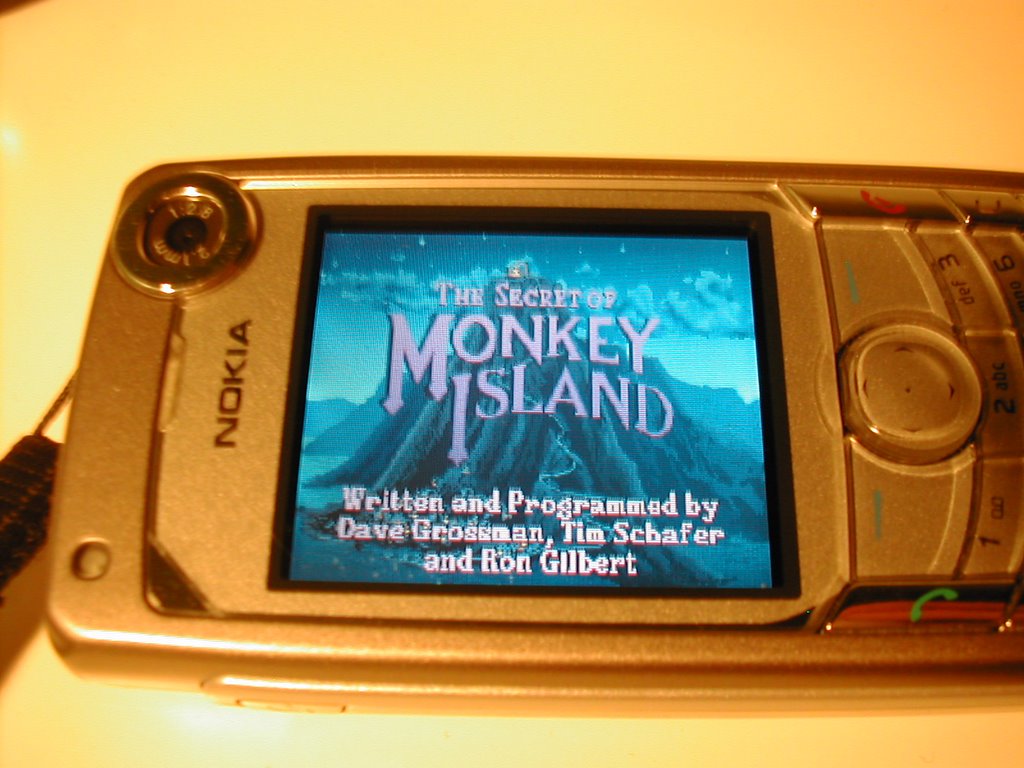
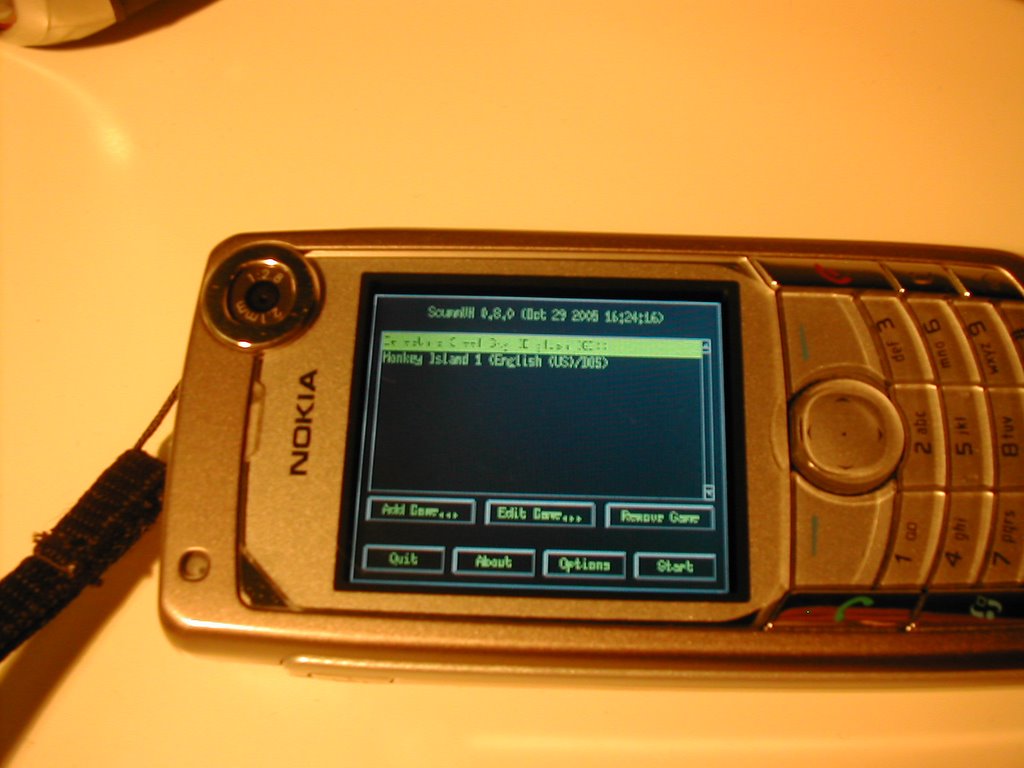
Apparently, not so. The crazy genius who ported this made it work on my phone, and today the executables were released to the public. Well technically, it was yesterday, but time flies when you're having fun.
Now, this is ScummVM we're talking about, so suddenly I can play all sorts of games on my phone, not just LucasArts classics.
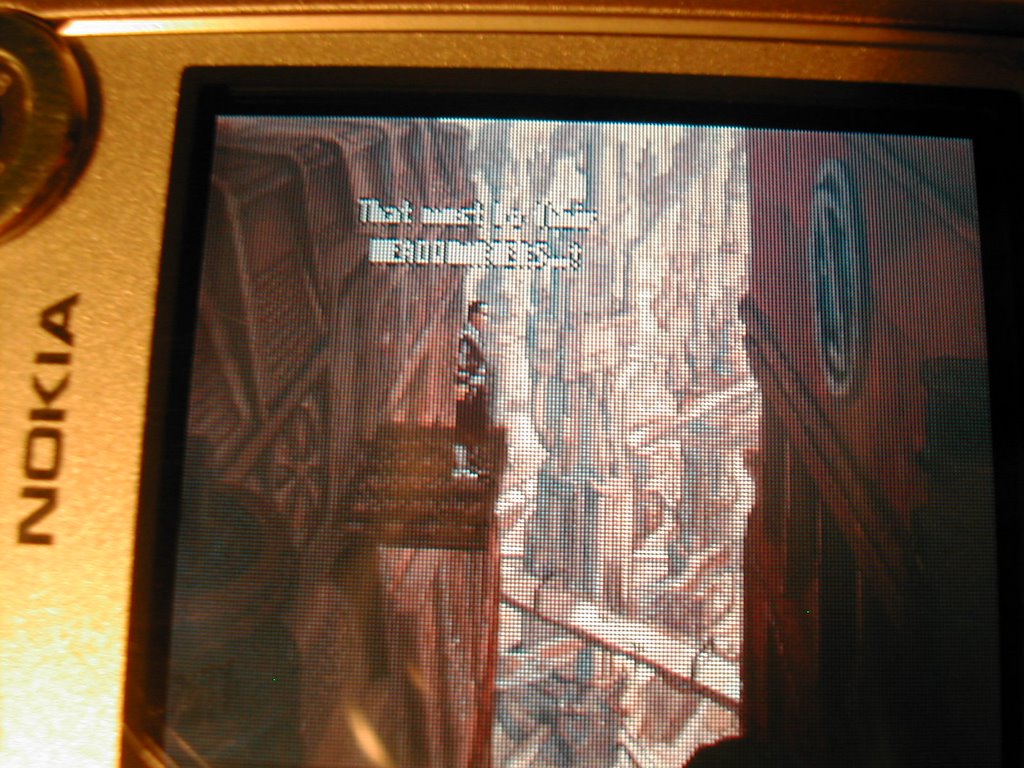
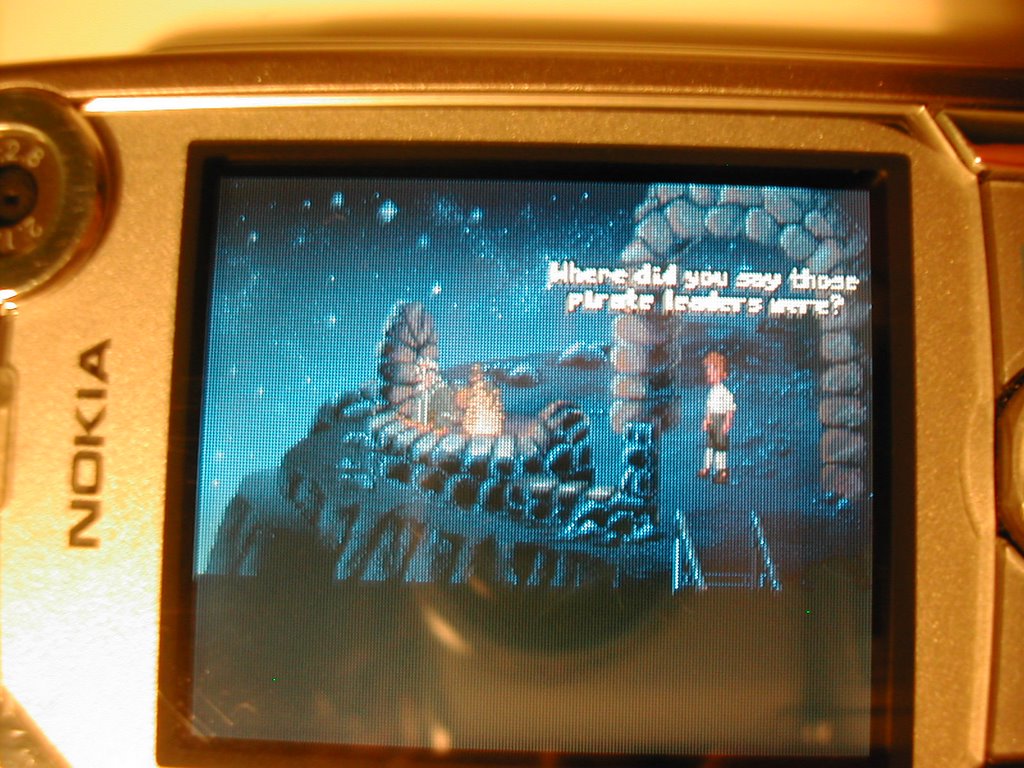
Unfortunately, the sound only has one volume setting as of yet: ear-piercingly loud. I'm hoping they'll fix this, because now I have to connect my headphones and use them as loudspeakers, which is not a great solution. On the plus side, it's sound! I can hear Michael Land's brilliant iMUSE music on my phone! I'm running out of exclamation marks!
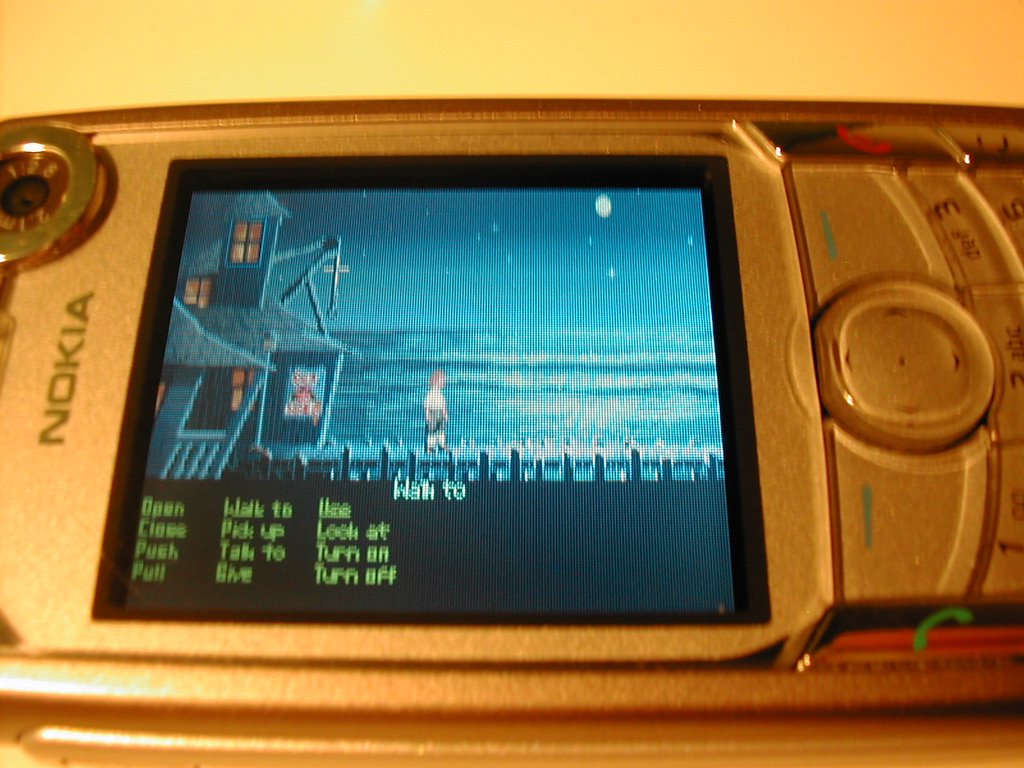
Well... I guess it's simply a miracle.
Subscribe to:
Posts (Atom)

