Showing posts with label review. Show all posts

Tuesday, October 02, 2007

Amazon's Mobipocket

Joey's bagAfter lugging around 1000-page books on the subway for a few months, I've come to realize that it's not a practical solution in the long run. It's a hassle even when the weather's fine, so I'll probably give up when winter starts. The problem is that a book this big doesn't fit even inside my relatively large pockets, which means I either need to go about my daily life one-handed while fumbling with the book in the other hand, or get a bag to put it in. As much as I love and respect Joey, I don't share his love for man's bags, stylish though they may be.

Enter technology. I remembered hearing about Mobipocket, an e-book reader that runs on your phone and enables you to read books in digital format. I visited Mobipocket.com and had a shiny new book on my phone within minutes. Yes, I actually bought a book almost immediately, which is unusual seeing how stingy I can be. I boycott restaurants that I think are too expensive, and I hardly ever buy anything if I don't feel that I really need it. Thing is, I couldn't pass up their deal on Peter F. Hamilton's Night's dawn trilogy. If I'd bought those three books in paper form for the cheapest price I can find in Sweden, they'd sum up to 340 SEK. At Mobipocket.com, the entire trilogy in digital form is 79 SEK. Three e-books, cheaper than a single paper book. The price was worth it to just try out the software and see if I'd be comfortable reading on my mobile phone.

As it turns out, I kind of miss turning real paper pages, and the glare of the LCD screen can be irritating at times. However, there are just so many benefits. The weight, for one. I recently moved, first to a new town and then to a new apartment in the same town within a year. During that same year, I helped my parents move. The experience convinced me that a box full of books must be among the heaviest things on Earth. If all my books were digital, they would all fit in my pocket and weigh next to nothing. Secondly, I now always have a book handy, since I always take my phone with me wherever I go. No more sitting on the subway (or toilet) longing for something to read. Actually, now I can even pretend to do something relatively important and relevant with my phone during boring meetings when in fact I'm engrossed in an epic battle between organic starships and their mechanical counterparts. Third, as I've already mentioned, the price is right. Mobipocket has apparently been acquired by Amazon.com, which started out as an online bookstore and thus should have some experience in the field. Finally, as if you even needed a fourth reason, you can never lose a Mobipocket e-book since you can simply download it as many times as you want from the website. Also, e-books don't tear or get soggy, and nobody can ruin them by scribbling in them or underlining entire passages of text. Well, Mobipocket actually lets you enter notes in books, but it's purely optional and you don't have to view them, which does make it a feature as opposed to the eternal scourge of booklovers everywhere.

The only problem I have now is that I have too many books to read. My latest impulsive purchase brings me to a total of eight unread sci-fi novels. I have some catching up to do.

Monday, October 01, 2007

Pandora's Star

Tuesday, July 31

I am currently reading Pandora's Star by Peter F. Hamilton. I'm on page 163 of 1144, which seems a ridiculous length for a novel, but it's so good I'm already one tenth in. I've decided to simply add my experiences to this post as I go along.

In a book of this size, you're bound to stumble across a curious turn of words here and there, but some of them seem intentional, such as "[...] Wilson walked along a long, meandering gravel track [...]", or when describing the layout of a starship development complex, "[t]he complex layout was simple enough." I like to think that Hamilton wrote these phrases off the top of his head, spotted the rhymes and ostensible paradoxes and amusedly decided to keep them, wondering if his readers would spot them as well. This sort of shared jokes with the reader appeals to me, because then I get to squeal "I caught them, Mr Hamilton, aren't I clever, look at meeee!" Needless to say, it's a deeply satisfying experience.

Thursday, August 16

I'm now at page 422. It took Hamilton around 200 pages to impart much the same information as the summary on the back of the book, while adding a substantial amount of detail and a secondary plotline. He sheds light on the year 2380, when the human race is organised in an Intersolar Commonwealth. Through the use of wormhole technology, it spans several solar systems, as the name implies. During these 400-odd pages he has also relatively briefly, albeit in great detail, touched upon the lives of three seemingly random inhabitants of the Commonwealth. It's a titillating technique that leaves me wondering if and how he'll reintroduce them into the main story.

During their travels, humans have chanced upon a few sentient alien races. These are casually referred to early on in the book as if we already know who they are: for example, the Silfen and the High Angel, both with such interesting names it's almost painful to have to read through nearly 300 pages until Hamilton actually starts delving deeper into who these alien races are. I have to say, this book is definitely not for the inexperienced or impatient reader, but having said that, it's consistently well written and never dull.

Monday, August 27

Page 562, and still no end in sight... Sorry, for a moment there I imagined dedicating a blog solely to a page-by-page report on my arduous progress through this book. I quickly abandoned the idea, as my progress isn't arduous at all. By mid-book, famous police investigator Paula Myo solves a case, one of the seemingly ephemeral characters I mentioned earlier has been fleshed out and given a very foreboding plot, and finally a specially built starship, the Second Chance, sets off towards the titular star of the book. There's a substantial change of pace at this point as Hamilton exclusively reserves a whole chapter for describing the journey of the Second Chance and its thrilling encounters with alien technology. The story-telling is more focused, and the book subsequently becomes a real page-turner. I'd say the pacing is flawless; I'm at the first peak of the rollercoaster, and I just hit the point of no return. I'm glad I held out -- a normal-length book would be over by now.

Wednesday, August 29

I've only read a couple of pages since the last update, but I just wanted to hypothesize about the alien encounter in the middle of the book, and the reason their civilisation seems unexplainable to the crew of the Second Chance.

Click to view spoiler

Tuesday, September 11

Current page is 735. I was pleasantly surprised that one of the fleetingly mentioned characters from the first half of the book was reintroduced on page 666 and revealed to be the first-born of the head of a ridiculously rich and powerful family. The story took a break from the action and focused on political intrigue for what seemed to be a very long chapter, albeit strangely fascinating. Hamilton also adds in a loose end from the Paula Myo case in the form of the defendant's girlfriend, now broke and helpless. At this point, I was disappointed that Hamilton blatantly reused not one, but fully two concepts from his earlier novel Mindstar Rising, which rather taints the experience for me. I'm hoping he at least takes this storyline in another direction than he did in the earlier instance.

There's still a character that pops up now and then who doesn't have a clear purpose. So far, he hasn't had any impact on any of the major storylines, but he has served as an outside spectator, adding vivid detail to the Commonwealth universe. Also, one of the storylines (an exploration of the exotic worlds inhabited by the Silfen) is finally getting interesting.

Tuesday, September 25

On page 894, Hamilton returns to the outside spectator's view of the main plot. It's actually a welcome human perspective now that the Commonwealth is preparing for war, and still the politicians are thinking in terms of polls. Tension is building, and it seems like the focus of the storytelling is shifting more often, quickening the pace. As for the alien threat, it's been thoroughly explained at this point, and I was basically right. Yeah, I'm smarter than the brightest minds of the 24th century.

Monday, October 1st

Finally put aside some time to finish the book this week-end. Strangely, the side-plot involving the exploration of the Silfen worlds slowed down again, and contrasted rather heavily against the action-packed war against the alien invasion. I would have welcomed an even more focused storytelling near the end, since at times I felt that I had to trudge through some less interesting paragraphs to get to the juicy bits. Thankfully, the pacing was high and I was quickly rewarded for my perseverence. The pace revved up considerably toward the end while weaving together several plotlines, which made for a raffling finale.

It was also a rather special feeling to pass the 1000-page mark. Reading a book this long actually feels like somewhat of an accomplishment, and it was definitely good enough for me to immediately get started on the sequel, Judas Unchained, which weighs in at a hefty 1234 pages.

Monday, July 30, 2007

Black Man

Richard K. Morgan writes gritty, no holds barred sci-fi that feels as real as a kick in the nuts, and Black Man is no exception. This novel does exactly what good sci-fi should do; start with reality, take an aspect of that to its extreme, and watch it play out to its logical conclusion, all the while telling an engaging story with believable characters and unraveling a mystery that keeps you on the edge of your seat. A tall order perhaps, but as usual Morgan delivers on his promise.

That's what the blurb on the back of the book would have said if I were a famous sci-fi author. Instead, there's some high praise from Peter F. Hamilton, who shares quite a few traits with Morgan, as I've already pointed out. That's fine by me, although I still think my blurb is better and more to the point.

The black man referred to by the title of the novel, Carl Marsalis, turns out to be an african european who is genetically designed for war, a specimen of the thirteenth official variant of the human DNA, which emulates the hunters and gatherers of yesteryear. So called "13s" aren't known for their team building skills, but Marsalis grudgingly pairs up with female COLIN agent Sevgi Ertekin to track down a fellow 13 that has somehow escaped the Mars colony, crash landed on Earth, and is now on a seemingly random killing spree. As "out there" as this storyline may seem, it boils down to a surprisingly realistic mystery sprinkled with some social and religious commentary that is well worth considering. For some, Morgan's sci-fi may even be too realistic, since it doesn't really offer much in the way of escapism as it deals with racism, religion, politics and death. It's really more of a hardboiled novel, with sex, violence and the stereotypically cocky, uncaring male protagonist, although it will eventually surprise you again with depth of character and heart wrenching developments that had me sniveling in a crowded subway car, making a fool of myself.

I guess that's the trademark brilliance of Morgan's novels; they have everything.

Saturday, July 28, 2007

Nothin' but a short time

I only bought the game yesterday, but I have now played through Guitar Hero: Rocks the 80s on both Medium and Hard. It's not as if I played it non-stop either; it took maybe four or five hours in total. There are only 30 songs in career mode, and no bonus songs. That kind of pissed me off, because I wanted to hear some 80s style rock from contemporary bands, maybe some Harmonix employees.

In contrast, Guitar Hero II had 40 songs in career mode and 24 bonus songs. Length-wise, Rocks the 80s really is a joke in comparison, and most of the in-game artwork consists of poor rehashes of content from Guitar Hero II. Calling it an expansion and peddling it as a full-priced game to wide-eyed Guitar Hero fans itching for their next fix is just mean. Is Activision hedging their bets by making the game just replayable enough that we'll be bored of it by the time they release Guitar Hero III (which will cost only €3 more than Rocks the 80s)? Is Harmonix pouring their souls into Rock Band, while just fulfilling some contractual obligation by completing Rocks the 80s? Probably a bit of both.

I have to admit though, a lot of the songs were really good, and some came as pleasant surprises since I made it a point not to read the track list beforehand. I got so much neck-button mashing action that I got a bit of a cramp in my left hand, and I think I'm getting the hang of hammer-ons and pull-offs. I finally noticed that those notes don't have a black outline. So thanks for the exercise, guys. Now where's the rest of the game?

Sunday, July 22, 2007

Capacity

Tony Ballantyne's Capacity has one of the best sci-fi prologues I have ever read. I bought the book solely because the first few pages read like an introductory pamphlet for people whose personality has recently been copied into processing space, a virtual reality where people from the atomic world are so accurately simulated that they garner human rights of their own as Personality Constructs. The pamphlet explains all this and more, and thus also serves as a perfect introduction for the reader, easing you into the storyline even if you do as I did and skip the first novel of the trilogy. (The first book, Recursion, wasn't available in the store so I just picked this one up.) The actual story kicks off with a cursory introduction of the main character Helen, and then her death. Suddenly the story twists around in a loop, apparently into the past, to describe a minutely different version of reality where Helen is alive, until she proceeds to meet her fate in a slightly different turn of events. This loop reiterates a few times, showing still other variations, until Judy, a kimono-clad mysterious agent of Social Care, appears out of nowhere and saves Helen.

Ballantyne's prose tickles your imagination and challenges your intellect. His vision of the future is exotic almost to the point of being completely alien, and many of his descriptions are dreamlike, almost nightmarish. There is a pervasive mood of hopelessness and inevitability, and the underlying theme seems to be that the human race cannot possibly grasp the sheer enormity of life's most important questions. The book throws a barrage of existential conundrums at the reader. The first one is on the cover: If you are copied, who is the real you? The rest are presented in dialogue and plot and elaborated upon from almost every possible angle. What does it mean to exist? Thinking? What if there are sentient robots? Identity? What if you can be copied? Reproduction? What if there are reproducing machines? The seemingly endless philosophising would get tiresome if it weren't for Ballantyne's careful pacing.

Thankfully, the book is not all about Helen and Judy's travels through Existentialism 101. Helen's story interweaves with the story of Justinian, an expert on Personality Construct psychology who has been brought to a recently colonized planet to investigate the suicides of several artificial intelligences. His dialogue with the AIs and his accompanying robot Leslie is pure genius. Sure, it contributes to shedding light on some of the existential questions raised by the parallel storyline, but it's not nearly as blatant. It lends heart to the story, and some feeling of purpose, as Justinian is the most sympathetic character in the book.

My final impression of the book was that there was no actual story, because every plot element and every piece of dialogue seemed only to present new permutations of existence and thereby elaborate upon questions of its definition, cause, effects and limits. However, a book without a story is definitely not a bad thing, especially when it's this well-written. Suffice to say that I went back and bought the other two books in the trilogy.

Sunday, June 24, 2007

Thy next foe is...

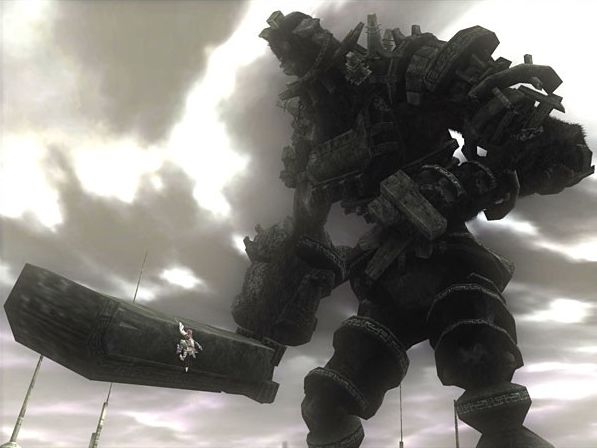
I've climbed the mangy fur of a stone giant with my bare hands, hanging on for dear life as it shook and bucked with such force that my vision blurred. I've stood atop a mountain-sized creature and suddenly realized that I was far up in the clouds, circled by birds and only one step away from falling back to an earth obscured by distance, ultimately meeting my maker. I've performed death-defying leaps from one wing to the other on a flying behemoth, and nearly been swept away by the oncoming torrent of wind as it raced through the skies. I've been plunged into the depths of a murky lake while stubbornly holding on to the glistening tail of a gigantic electrified sea monster trying to drag me down into a watery grave.

Every time I am faced with another colossus, defeating it seems an impossible task. What could I possibly do that would even faze these enormous creatures? I am an ant in comparison to these insurmountable obstacles, each one a new adventure, another unique challenge. The dizzying heights, neck-breaking speeds and mortal dangers leave me sweating and shaking with exhaustion, even though I am sitting safely on this side of the screen, controlling the protagonist via a gamepad and watching the action play out before me. Because I am of course talking about a video game, namely Shadow of the Colossus for Playstation 2.

I am a severe latecomer to the world of PS2 gaming -- in fact, I only just bought the console some week ago after being mesmerized by Guitar Hero, and then recently decided to get a few cheap games. Shadow of the Colossus is more than a year old now, but it still looks good (and sometimes amazing) if you can coax some 480p action out of the PS2. Just getting my hands on the required component cables to take advantage of the higher resolution was somewhat of an adventure in itself, as most game stores nowadays only carry accessories for Xbox 360, PS3 and Wii. I found PS2 component cables online, but didn't want to order accessories from some unknown web shop. I finally found an actual real-life shop that has component cables right here in Stockholm; the appropriately named psXcare. Thanks guys, now I can defeat colossi in twice the resolution!

As a side note, I was a bit ticked off at first by the sound lagging behind very noticeably in cut scenes when playing in progressive mode, but then I switched from PAL to NTSC, and now it's in sync again. Apparently, it was that age-old "timing based on hertz" problem that I thought died with the 80s.

When I first got the game, I was a bit anxious that it would be too hard for me, since I'm not much of a gamer. As it turns out, it's very forgiving, despite pitting you against otherwordly giants that would just as soon crush you underfoot as look at you. Firstly, the game only consists of two elements; finding a colossus and defeating it. That's it. Finding the next colossus involves riding across the land on your trusty steed and holding your sword up to the sun to see in which direction it focuses the sunrays; that's where you need to go. Most jumping puzzles take place during the actual felling of the colossi, and there are no other irritating enemies running about. Secondly, falling off a colossus or getting stomped on usually doesn't kill you instantly. One of the worst things that can happen is that you lose half your health and your consciousness for a while, which leaves you very vulnerable to any further attacks. However, if you can just get out of harm's way for a while, your health is automatically replenished. Of course, if your health meter is depleted, it's game over, but you don't have to load a game and ride all the way to the colossus again; you get to start over from the moment you found it.

Once again, this is what I would call soft obstacles. There is no instant failure, and every time I fall off a colossus I feel like I've discovered something new about it that might help me defeat it. Still, I'm only half way through the game and I've almost given up twice. The problem is that it's too linear. There is only one colossus to fight at any given time, hence the title of this blog post, the phrase with which every mission starts. You can easily get stuck on one colossus with no clue as to how to defeat it, or just get frustrated by how hard it is. If there had been two or three colossi to choose from, you could leave one for later and defeat a few of the others instead, thereby maintaining the flow of the game. Granted, multiple colossi might make finding them a whole lot harder. It would be slightly akin to having a compass needle that not only points north, but also towards Havana and Sofia depending on which way you're facing. Any potential solution might break the design of the game, which is elegant in its simplicity.

So while Shadow of the Colossus is not perfect, it's an extremely satisfying experience. The music is great, the colossi are awe-inspiring, and the story seems to build up to what I hope to be a heart-wrenching and memorable finish. Now if you'll excuse me, I believe I have a sand worm to slay.

Monday, June 11, 2007

Mindstar Rising

Like Richard K. Morgan, Peter F. Hamilton writes sci-fi and has an abbreviated middle name. And much like Morgan's first book Altered Carbon, Hamilton's first book Mindstar Rising bears a title composed of two words and tells the story of an extraordinary individual who solves a mystery. Also, both authors are British, as well as brilliant. Unfortunately (for you), it's been too long since I read Morgan's novels to crisply detail his brilliance. Luckily, I just read Hamilton's Mindstar Rising.

To keep me interested, a book should have a good mystery, believable characters in somewhat believable situations, and at least one gimmick. Take Harry Potter for example. He solves mysteries and is constantly developing as a character. The gimmick is the magic school of Hogwarts. In Mindstar Rising, Greg Mandel solves mysteries and is at times almost painfully realistic in his interaction with a series of increasingly deadly situations. His gimmick is his intuition, which has been enhanced by a military-grade neurohormone gland, lending him full-blown psychic powers that allow him to sense and even alter other's thoughts.

Not satisfied there, Hamilton adds a few other gimmicks in the same vein. Greg teams up with his old army friend Gabriel, a woman who can see into the future, and with Julia Evans, a girl with bioware implants that make her a living breathing computer, besides being the teenage heir to the most influential economic power in a communist-savaged Britain.

The brilliant part is how well Hamilton describes these abilities. Greg sees each mind as a blob of colours, seething and writhing with readily identifiable thoughts and feelings, some of them shooting out like spikes or surrounding a person's head like a halo. Gabriel sees all possible future events flowing down converging timelines into the present, a mystical forking river she refers to as "tau lines". Julia's power is similar to both Greg's and Gabriel's in that she can instantly recall and process such great amounts of information that she can foresee events with some certainty, deducing motives and playing people against each other like pawns, her mind ablaze with data coursing through logical matrices that effortlessly search and filter all possible answers until only one remains.

I also liked the pacing of the book. The first 100-or-so pages form a rather straight-forward first act where the reader is introduced to the main characters, getting a good taste of their backgrounds and personalities. It's nearly a self-contained story, having a resolved mystery and a bittersweet ending that lures you in, only for the second act to open up with a flurry of surprises, bringing you in for the kill.

Among the more interesting recurring themes are abnormality and isolation. Both Greg and Julia have a hard time relating to other people and living a normal life because of their abilities, and they are both eventually forced to come face to face with their humanity and mortality.

Well worth the money; I'm definitely reading the next two books in the Greg Mandel trilogy.

But first I have to finish Tony Ballantyne's Capacity, which I just started. Of all sci-fi books I've read thus far, Capacity easily has the best prologue. It made me smile and surprised me both with form and concepts. Here's hoping that the rest won't let me down.

Tuesday, April 10, 2007

Squeedly vs meedly

"Guitar Hero II might appear to be a game, but it's actually composed of cleverly packaged pockets of productivity-sucking awesomeness created by Satan." - Total PlayStation

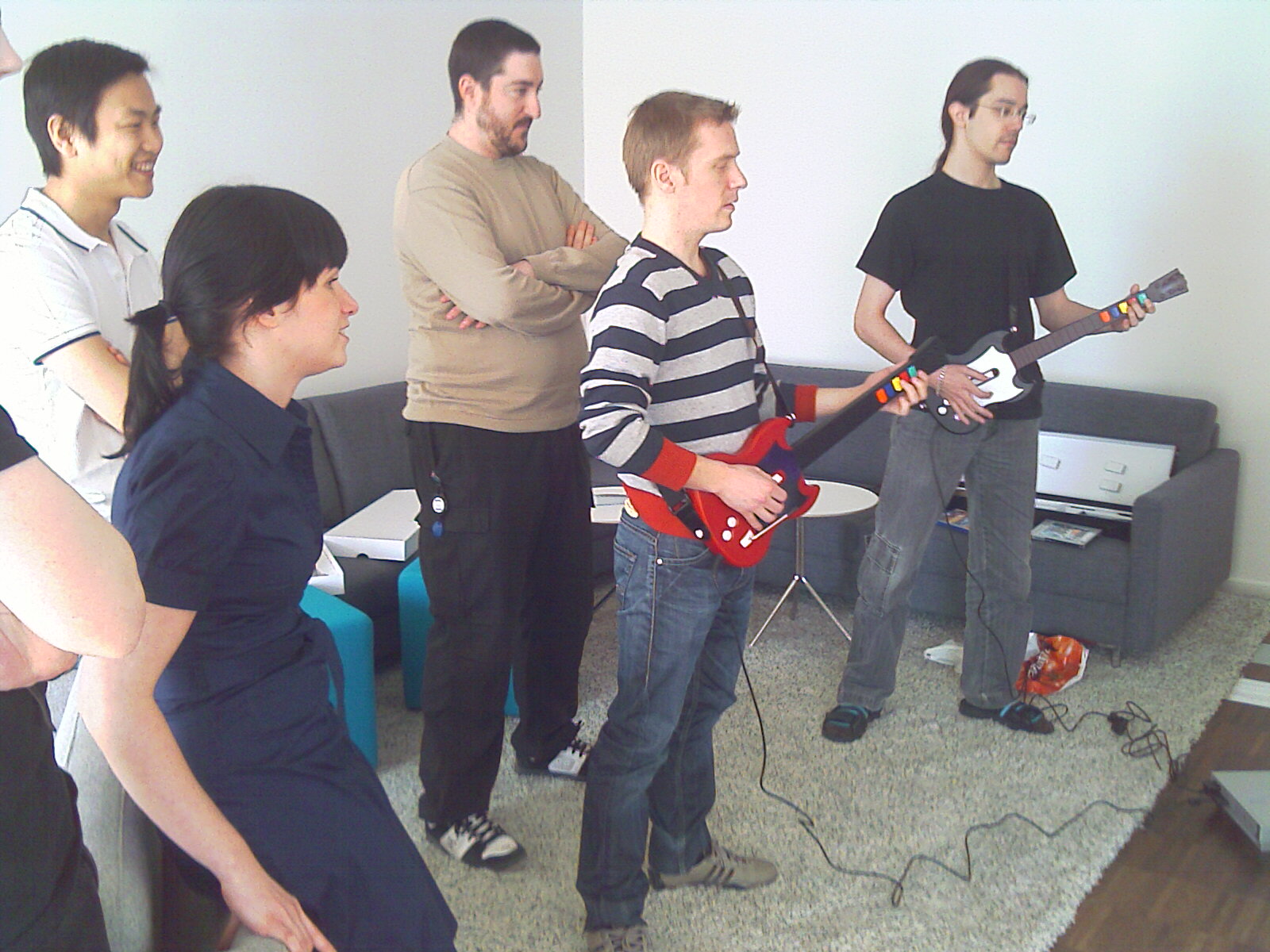
Several of my workmates were inclined to question my sanity when I recently purchased the PS2 game Guitar Hero despite not owning a PS2. Since this was before playing Guitar Hero, I still had some semblance of rational thought; my plan was to play it on a PS2 that a friend had brought to the office. That day, I stayed at the office until 9 pm. I then borrowed the console for the weekend, during which I strummed and thrashed my way through the game on medium difficulty. The game makes you look silly, with its child-sized plastic guitar controller, but it really makes you feel like you're playing a real instrument, and playing well at that; I got 5 stars on most songs on the first try. The end result was that I bought Guitar Hero II as well last Tuesday, complete with another guitar so I could play with my brothers, and borrowed a PS2 indefinitely from another friend who is currently deprived of a TV to which to connect the console.

Thus began my downfall. The game harbours a ridiculous amount of fun, especially in the multi-player modes. It's entirely skill-based and chock-full of soft obstacles, which suck you into the flow of the game. It's hard to stop playing, when you can always play "just one more" song, or play a song again and again to nail those awesome solo licks. When my younger brother and one of his real-life band mates came to visit during Easter, our living room was suddenly transformed into a rehearsal studio when they decided to hone their skills on Killing in the name of, playing it maybe 15-20 times in a row.

The game is deceivingly easy to get started with if you have some rhythm perception and hand-eye coordination, and is nearly open-ended if you strive to perfect your scores on the expert difficulty. In other games, different difficulty levels do not equate replayability, at least to me, since the added difficulty doesn't add to the experience. In Guitar Hero, the higher the difficulty, the more your fingers are following the licks and riffs, and the more it feels like you're actually playing the song. Speaking of difficulty levels, the separate difficulty settings in cooperative mode is a stroke of pure genius. Now my brother, former guitar virtuoso, and his girlfriend, self-proclaimed music illiterate, can play together and thoroughly enjoy themselves.

Basically, Harmonix have done everything right. The only possible fault I can find is that the games are too short. I eagerly await Guitar Hero III and Guitar Hero: 80's edition.

Sunday, March 11, 2007

Alternate reality

A game belongs to the alternate reality genre if its in-game world crosses over into the real world. That in and of itself is a rather interesting concept, although whenever I read about Majestic back when it came out, I kept thinking that it seemed like too much work. You have to interact with things in the real world to play the game, which often involves calling phone numbers or searching the web in order to reveal clues that advance the plot of the game. If you'll recall, I'm a very casual gamer. Searching for clues in video clips or painstakingly assembling stray words in background images from different websites to figure out which book they're quoted from doesn't seem very appealing to me.

Alternate reality games (ARGs) always seem to suffer from two faults: the solid wall and the deforestation. ARGs are a solid wall when they are composed of too much information/disinformation (I Love Bees) or too little information (The Lost Experience), so that you can't even see which part is a clue, or if it's even a game at all. Even if you do, you can't follow the clues if you don't spend an inordinate amount of time on them, which is hard if you have a life or a job. Most ARGs also suffer from deforestation, in that they are often being played by thousands of people simultaneously, so there is nothing new for you to discover. The web is plastered with clues and spoilers that are hard to avoid if you're actually trying to play the game. Your quiet stroll through the forest, picking your favourite flowers, has been destroyed by masses of people trampling every flower underfoot.

Like Majestic, ARGs often strive to seem real, and to make you think you're not playing a game. More often than not, you aren't. These days, ARGs are just big hype machines, utilizing the new and hip "viral marketing" concept to ingrain yet another trademark deep into your consciousness. I Love Bees was a complicated advert for Halo. The Lost Experience took it even further by endorsing Sprite, Jeep, Verizon and Monster.com. And now, for some reason, Nine Inch Nails has succumbed to this form of advertising with an ARG promotion of the upcoming album Year Zero.

I admit that the concept for the album is cool, but that's no thanks to the ARG. Trent Reznor wrote the concept; the ARG is just obstructing and cheapening it by in essence being a silly hype machine. I do enjoy looking at some of the websites and seeing The Presence, but I can't help but feel the deforestation syndrome. Each one of these websites is already plucked clean of every piece of information. Where's the reward in finding something that someone else has already found?

It's not all bad though. I like the "leaked" MP3s (a very bold move), and the teaser trailer. I suppose a good thing about viral marketing ARGs is that they're free, and I can choose my own level of involvement. However, in most cases my involvement is close to none.

Wednesday, March 07, 2007

You can't kill the metal

So, I was listening to the soundtrack of The Pick of Destiny again the other day. When I first saw the intro to the film, the song Kickapoo, I was blown away by its comic musical stylings, the two rock legend cameos and the flawless segue into the theme of the opening sequence. I already enjoyed the brilliant musicianship, but this time I discovered something else.

In the song, young Jack Black performs a rock song of his own for his family, in which he waxes lyrically about his expletive-loaded encounter with a dragon, for which he is admonished by his staunchly religious father Meat Loaf. Of course, all of this is communicated to the audience through song. Black's song is clearly heavy metal, with a classically inspired melody and fantasy lyrics, while Loaf sings soul, with religious lyrics and a bluesy vocal. The fascinating thing is that if you listen to the vocal phrasing and chord progression, the two melodies are actually one and the same. One could easily conclude that the young Jack Black of the film has inherited his musical skills, making the scene an allegory for rock music evolving out of blues and R&B.

I've seen some negative reviews of The Pick of Destiny, and it always sounds like the reviewer was watching a whole different movie. Maybe they just weren't looking hard enough. Where some people see only fart jokes and offensive language, I see all forms of genius.

Friday, December 29, 2006

Need for Speed™ Carbon

Today, I bought a new gamepad with analog triggers, to cure my lead foot. You could say it's a belated Xmas gift for myself. I've been playing Need for Speed™ Carbon for a while now, and using a digital button for throttle just wasn't cutting it anymore. It was nearly impossible to hit the sweet spot and get a perfect start, or even to accelerate out of a curve. The wheels would just spin like crazy, and my car would end up in a frontal collision with the nearest obstacle.

Still, I think I did pretty well. Above is my first car, an Alfa Brera. The cars in Carbon are divided into three tiers, where tier 1 consists of cars that are merely cool, while tier 3 has the insanely awesome cars. As you play the game, you gain cash rewards and unlock better cars. I decided to scrimp and save on my first car, only spending money on upgrading its performance. The idea was to have lots of money to buy a good tier 2 car. Besides, I really like the look of Alfa Romeos; they're so simple, distinguished and yet slightly terrifying.

The game started out by piquing my interest with some full-motion video. Yes, apparently I missed the return of FMV. It still bears a slightly awkward stigma from the 90s, but it's pretty well executed and I daresay rather engrossing this time around. The intro makes references to the previous game in the series, Most Wanted, which I should admit to not having played. Apparently it too featured FMV with the same stylistic flair, but took place in the daytime, while Carbon only has nighttime levels, much like the Underground parts of the series. Since I didn't understand the references, the plot felt unusually non-patronizing in assuming that I would be smart enough to catch the names of the characters and follow the rapid turn of events. Learning that this is merely a sequel and not an "after the fact" mystery inspired by Agatha Christie was actually somewhat of a disappointment.

As it turned out, I didn't have to save up for a new car; I won the tier 2 car of a defeated boss. The world of Carbon is divided into territories owned by rivaling street racing gangs. The car above is an Aston Martin DB9 that belonged to Wolf, the boss of the TFK gang, until I rolled into town, took over their territory by beating them race by race in their own backyard, and proceeded to defeat their boss in two one-on-one races. To cement your domination over a territory, you first need to win a regular street race against the boss, and then defeat them in a canyon duel. The duels are both frustrating and exhilarating, and involve tailgating the boss as best you can without falling off the canyon, and then trying to shake him off as he tailgates you in the second round.

My third car, a Mazda RX-7, is the result of overtaking Kenji of the Shinobu gang in a canyon duel, a move that leads to a near instant win. The Aston Martin just flew past like a cannon ball; the only problem was actually slowing down and not flying straight down the canyon wall. At this point, I was still using my old Logitech Wingman, and the game felt rather easy; the way I like it. I actually didn't race the Mazda at all. The Aston Martin became my mainstay, and I used it to beat the third gang, 21st Street, and their boss Angie. As you can see above (skip the Mazda), I decided to pimp it by painting it gold chrome. It ended up looking like an autobot about to transform, or maybe the steed of a modern day paladin. Either way, I think it's awesome.

The fourth territory is where I ran into trouble. Suddenly everyone's racing around in tier 3 cars, and you have to beat them to unlock tier 3 and get something raceworthy. Suffice to say that this is where morale takes a big hit. Sure, my golden autosteed looks cool, but it handles like a refrigerator. Was that a curve? Bam. OK, now that's a wall. Lost again.

Luckily, I had already ordered a Thrustmaster with analog triggers and force feedback, and with it I finally managed to unlock a Plymouth Hemi 'Cuda. This is a muscle car, by which they mean something that acts like it has a rocket up its behind and flails wildly all over the road. By racing the muscle car, I miraculously unlocked a tuner, a small Nissan 350Z that has great potential and handles like a god. This car in turn immediately left a few racers in the dust and unlocked the current love of my life.

Behold, the Lamborghini Gallardo. It's an exotic, which means its speakers blare hip-hop (as opposed to the tuner's trance and the muscle's stoner rock), and it's a real racer. It handles really well, although not as well as the Nissan, and it accelerates with a roar. I found a great body for it, and I settled on a dark purple chrome. The only problem now is to keep out of trouble, as the heat is high in the fourth territory. This means there's a lot of police activity, and they keep butting into every race, chasing me around after I've won. I usually shake them off, but even I got busted once, which means my poor Gallardo has incurred an impound strike. Three strikes and the car is lost. The heat is rising and those cops really seem to be after my ride.


Oh well, if they take this one I can always sell my crappy and ridiculously overpriced Plymouth and buy something even better. I must say, this game really got me hooked, and that's not an easy feat.

Monday, November 21, 2005

Dairy diary

Sweden is pretty big on dairy products. I've already posted photos of cows here, so you already knew that. What you might not know is that Sweden has a kind of dairy product that I'm not sure if it exists anywhere outside of Scandinavia, since I can't find a good translation for it. The closest I've come is "soured milk," but that sounds disgusting. So as to not upset any sensitive stomachs, I'll call it "fil" [feel], which is the Swedish name.

Fil is fermented milk, like yoghurt. I'm guessing that the difference lies in which bacterial cultures are involved in the fermentation process. Wikipedia backs me up on that, so I guess I'm right.

Apparently, a lot of Swedes enjoy pouring cereal in a bowl, and then pour milk in so that all the cereal goes completely gooey and unedible. Not me. I pour fil in my bowl, and the thick consistency can hold the cereal I pour on top. The result: Crunchy goodness, mine for the eating!

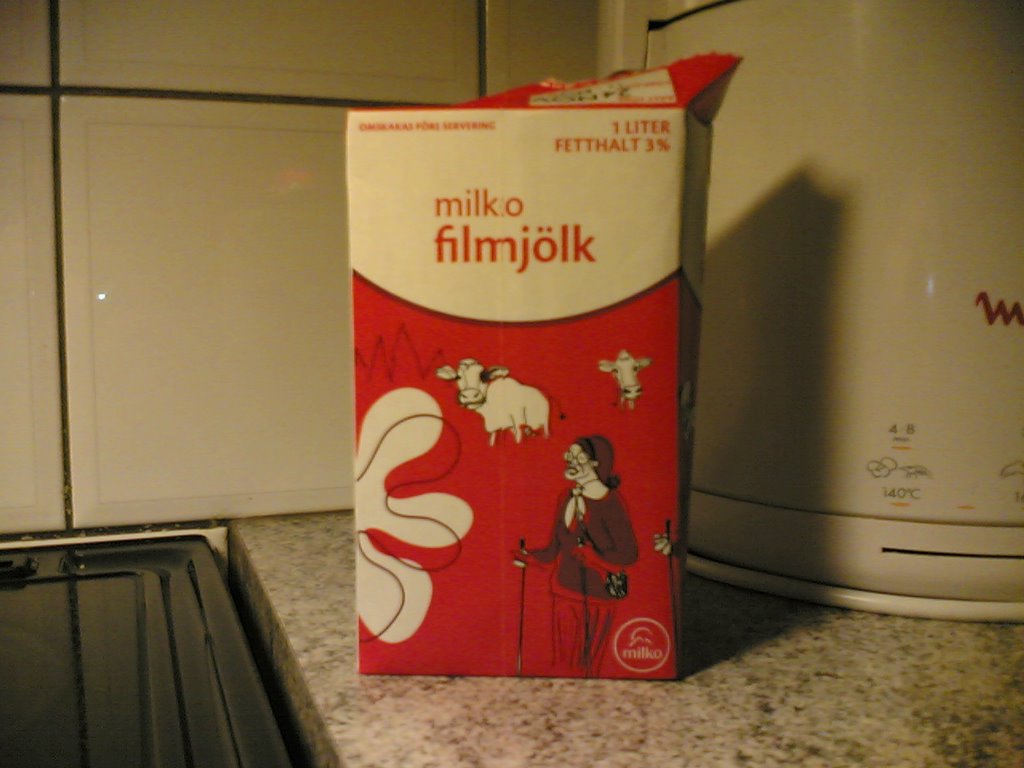
Now that you know what fil is, let's talk about the packaging. Above photo depicts a fil package. The photo next to this paragraph depicts a milk package. Fil packages used to be blue, which set them apart from milk with simple and effective colour coding. As of a few months ago, the two dairy products look very much alike. This can and has caused confusion, e.g. unwary people pouring fil in their coffee or splashing milk all over themselves, expecting the much thicker consistency of fil.

OK, maybe I'm exaggerating a bit, although mix-ups have happened. Now, from seeing only the front of these packages, you may get the impression that it can't be all that bad. After all, the red & white fields are inverted on the milk package. Telling them apart is easy as pie, right?

Well, let's take this once-in-a-lifetime opportunity to observe the dairy packages in their natural habitat.

You'll notice that the "spines" of the packages are very very much alike. Can you even tell them apart fully awake? If you can't, that's the fil package in the middle, with the subtle red & white flap at the top. The same flap on the milk packages is just red. Brilliant. Imagine that you're half awake, bleary-eyed and foggy-headed, straight out of bed (y'all betta make way). Of course you'll get the wrong dairy product every once in a while! Who's the dumbass who actually thought this idiotic redesign would be a good idea?! Gaaaah!

Sunday, November 13, 2005

Dan Brown

I just read Dan Brown's The Da Vinci Code, and I liked it. Not because it's an earth-shattering revelation, since most of what he "reveals" in the book consists of obvious stuff concerning pagan ceremonies and celebrations being embraced, extended and extinguished by the Catholic church. I mostly liked it simply because I liked the characters and their interaction, the pacing, and the twisting plot. At times, it felt like a movie made up almost entirely of chase scenes and miraculous escapes bordering on deus ex machina. This kept the tempo going, but it kept teetering on the edge of becoming ridiculous. Sometimes you really had to suspend your disbelief to enjoy it, which is much easier with movies that constantly barrage you with a flickering stream of impressive images (which means you might like the upcoming movie). Luckily, the plot was wrapped up in an adequately touching end.

Sure, there was a fun Grail theory I haven't heard before. Since it's central to the book, and one of the few actual elements of surprise, I'm not going to spoil it. Suffice to say that I enjoyed how Brown weaved art, symbology and religion into a nice little mystery.

I've just now started on another Dan Brown book, Digital Fortress. Unlike the above mentioned book, this one starts off slow, babbling on about the relationship between the two main characters. I don't know much about art and religion, but this book is about language and computers, which I know a thing or two about.

Amazingly, it doesn't take long before Brown displays his complete lack of research. At one point, one of the main characters is translating chinese characters, and when his employers aren't happy with his results, he suggests that the characters might actually be Japanese. I guess they might, except that this supposed expert linguist uses the words "kanji language" to describe the japanese usage of chinese characters. "Kanji language"?! Kanji is not a language! Brown kind of back-pedals in the next few sentences and does state that it's a japanese writing system, but then it becomes clear that he's under the misconception that the three japanese forms of writing are just three different scripts, and thus completely interchangeable.

Now, I'm almost willing to forgive this linguistic error, because out of the kindness of my heart I can replace the outrageous phrase "kanji language" with "man'yougana ". That's just because I happen to know that the first known written Japanese was actually written with only chinese characters used solely for their phonetic value. I just wish Brown would have done a little bit of homework and mentioned that in the book instead of some half-baked mumbo-jumbo, because this really puts me off from reading on.

The fact that I've now read reviews stating that Brown apparently thinks a 16-bit key consists of 16 letters doesn't make the book any more appealing...

Monday, October 31, 2005

Deep in the Caribbean...

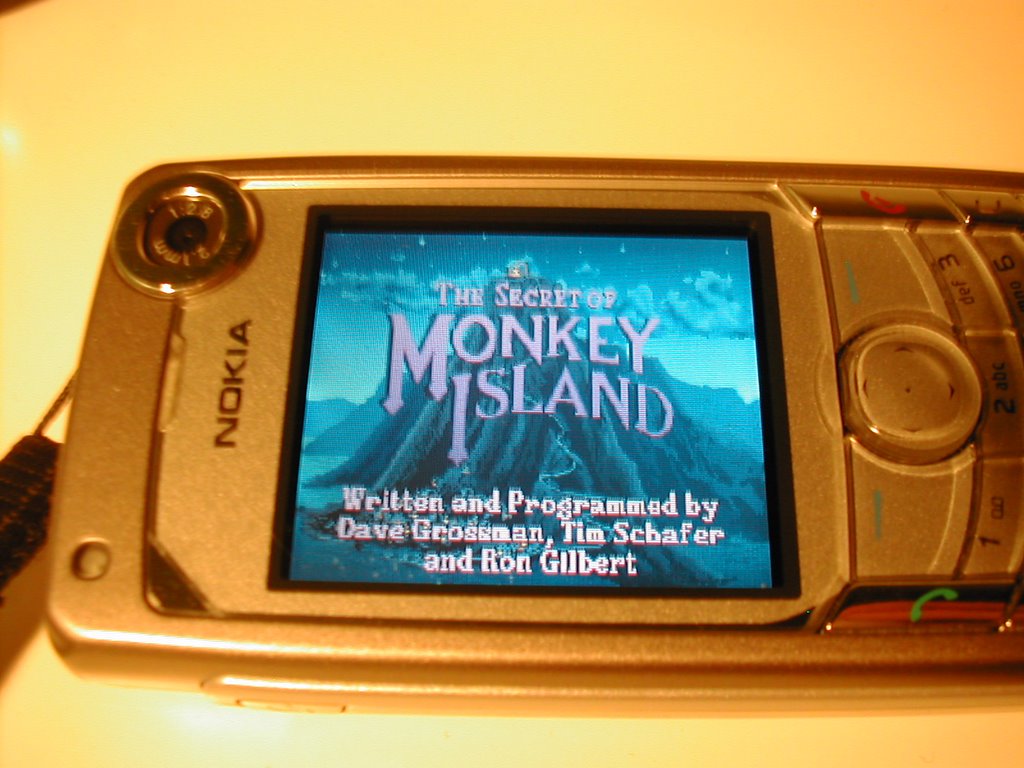
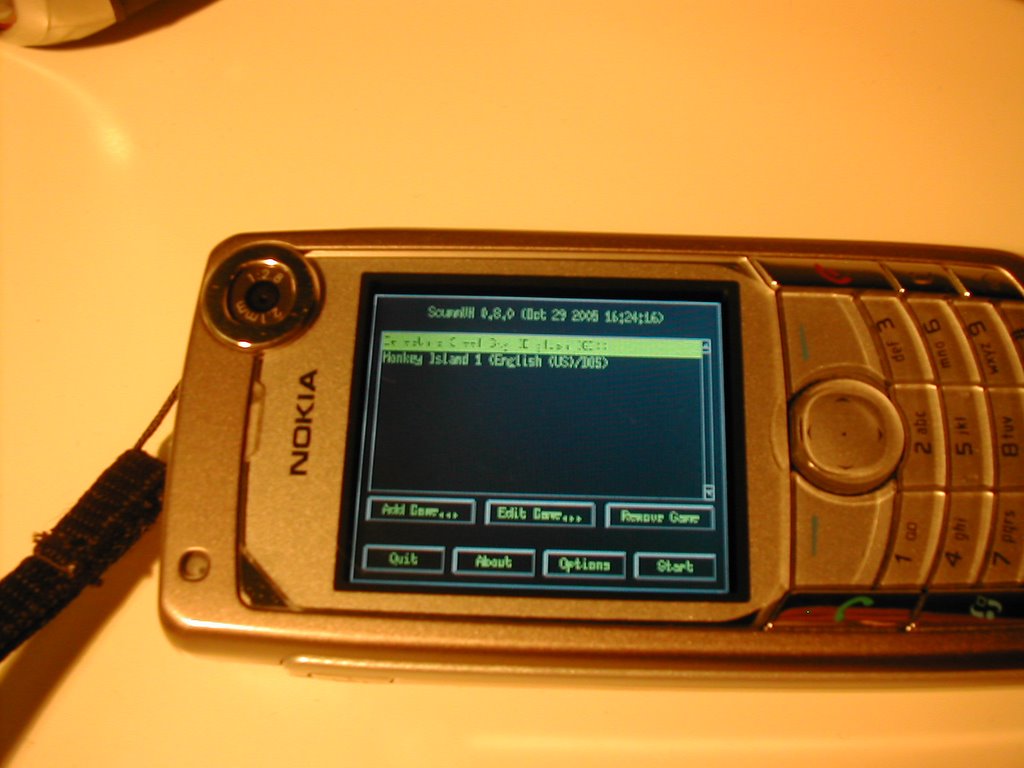
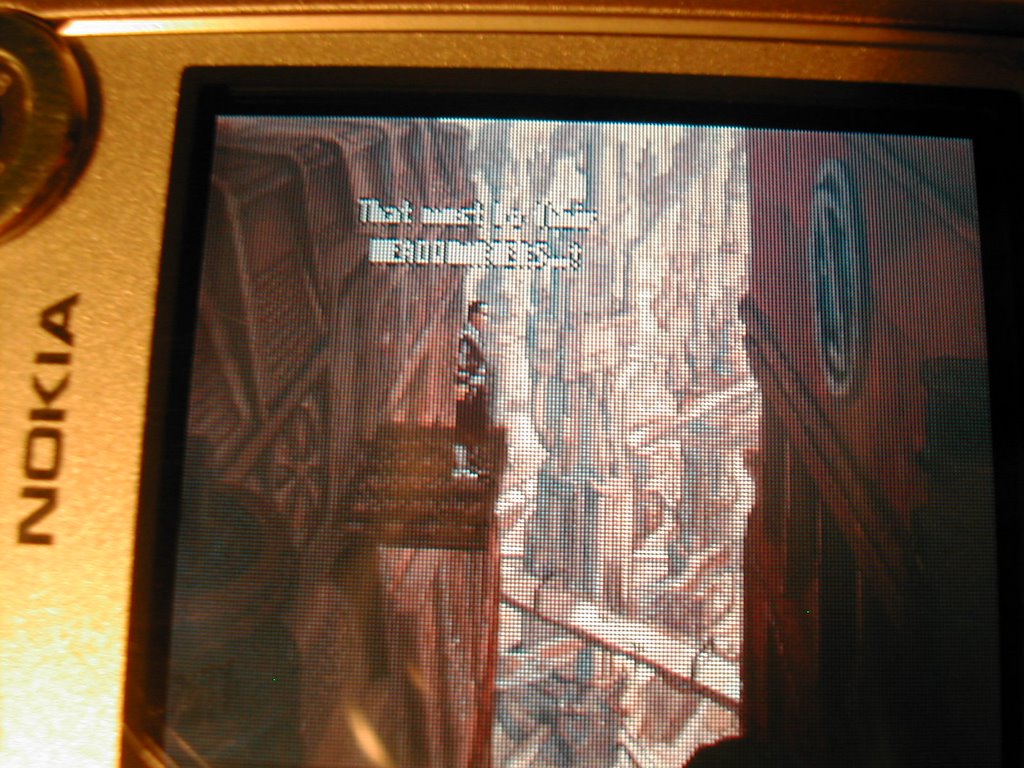
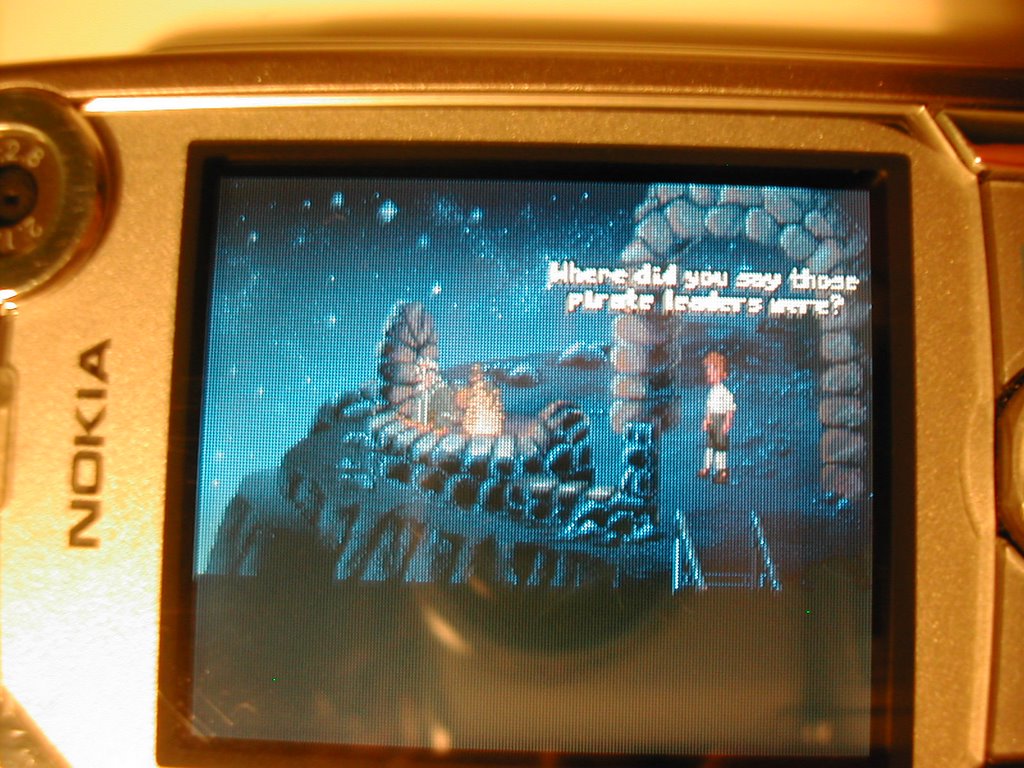
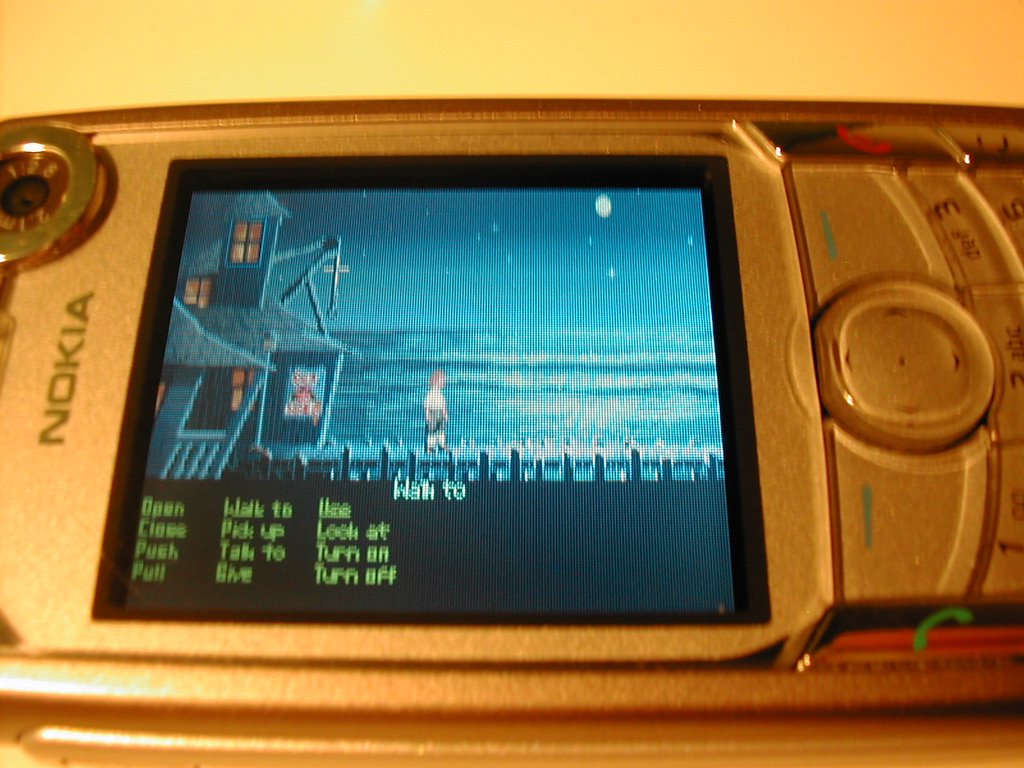
If you can't believe what you're seeing, then you're not alone. I couldn't either. But it's true! It's Monkey Island on a mobile phone. On my mobile phone! I can actually walk around with this classic in my pocket and play it any time I want. It might take some time getting used to, but I think this giddy feeling of euphoria might help me tide it over.

The porting of ScummVM to EPOC/Symbian has been in the works for a while now. I've known about it since the first EPOC patch was applied to the ScummVM CVS, but I never dared hope that they'd actually target the S60 platform. Surely, it had to be impossible?

Apparently, not so. The crazy genius who ported this made it work on my phone, and today the executables were released to the public. Well technically, it was yesterday, but time flies when you're having fun.

Now, this is ScummVM we're talking about, so suddenly I can play all sorts of games on my phone, not just LucasArts classics.

The screen is smaller than 320x200, so everything is scaled down to fit. Surprisingly, that's not at all noticeable for the graphics, but it quickly becomes painfully obvious that legibility is adversely affected. Basically, this means I can't read what anyone's saying in Beneath a Steel Sky. The font is rather narrow, and a lot of the outlines on the letters are missing. The strange love of ALL CAPS that the Revolution team exhibits in this game doesn't help matters; caps aren't exactly known for their readability.

LucasArts had a better font to start with. Their big blocky font has a nice and wide kerning. Apparently they weren't scrimping on screen estate, so their font doesn't suffer that much when it's scaled down. There's still the odd unreadable letter, but you can understand every word from context, especially if you've played the game before. On the other hand, that kind of goes for Beneath a Steel Sky too. I understood the intro dialog in BASS, since playing it again jogged memories of my three or four runs through it on the PC.

Unfortunately, the sound only has one volume setting as of yet: ear-piercingly loud. I'm hoping they'll fix this, because now I have to connect my headphones and use them as loudspeakers, which is not a great solution. On the plus side, it's sound! I can hear Michael Land's brilliant iMUSE music on my phone! I'm running out of exclamation marks!

Minor issues aside, the games work flawlessly. I can't understand how much processing power and memory my phone actually has. That these games even fit on my memory card is fantastic, and that they run without a hitch is amazing. It's ScummVM, for crying out loud! These guys know what they're doing, and it works so well you'd think the games were written for them, not reverse engineered by them.

Well... I guess it's simply a miracle.